The Red Bulls’ Star Period
Skating paths are a good keyword—especially when it comes to Munich’s successful second period. So far, the second period has belonged to us. The Red Bulls have already scored 27 goals in the second period this season, accounting for more than half of all their goals (51). This is clearly the best record in the DEL. Defensively, things are looking good, too. Only Straubing (ten) has allowed fewer goals than our eleven. With a +16 goal differential, we’re in a league of our own in the second period. Even David was amazed by the 27-11 goal differential. “Maybe we’re even better than I thought,” he smiled.
Why the second period is “different”
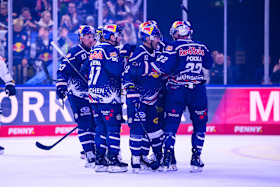
So it was no coincidence that we scored three goals in Augsburg during that stretch, sparking our comeback. Against Krefeld, another three-goal outburst followed, ultimately sealing our third straight home win. “That second period was the best we’ve played so far this season. The guys executed our game plan almost perfectly and were rewarded with goals,” our head coach said with satisfaction.
And this brings us back to the running patterns we mentioned earlier. Because footwork in the second period is particularly crucial. David explains: “The walk to the bench to get a substitution is longer. It creates a different rhythm. You have to play fast to stay in the forecheck. And of course, we have a system in mind for that.” Naturally, he won’t reveal what that is.
But one thing is clear: If a team gets pinned down in its own zone, tired players can hardly be substituted. The walk to the bench is long, and so is the risk of conceding a goal. And our guys have been able to take advantage of this many times so far…
A Shutout as a Reward
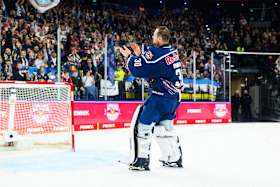
Antoine Bibeau has also been able to take advantage of the extensive ice time he’s received in recent weeks. Following Mathias Niederberger’s injury, our goalie has started the last five games, racking up four wins with a save percentage of 91.67 percent and a goals-against average of 2.23.