
Tuesday, 30. June 2026 |
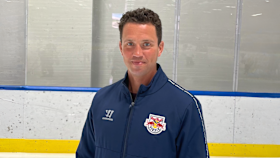
EHC Red Bull München: Interview with Goalie Coach Dimitri Pätzold
Dimitri, congratulations on your new role. What appeals to you most about working with the goalkeepers on the pro team?
Dimitri Pätzold: “First and foremost, the fact that, compared to working with youth players, you’re involved in competition in a different way. In youth soccer, as a goalkeeper coach for teams ranging from U9 to U20, you oversee many teams and work with all the goalkeepers in the club. Of course, you have a certain amount of influence there, especially on the goalkeepers and their performance. With the pros, you’re focused on one team and two or three goalkeepers. It’s a completely different way of working.”
What experiences are you bringing with you to the pros after your time in the youth ranks?
Pätzold: “The work is extremely different. Whether I’m working with an 11-year-old or a U20 goalie, that alone changes the nature of what I do and how I talk to the players. At the adult level, it’s a whole different story. The pros already have all the fundamentals down - they can do everything. It’s more about the finer points and details. And, of course, the interpersonal dynamics are completely different. Knowing when to say something - and when it’s best to say nothing at all - is crucial. I was able to gain that experience in Landshut, where I worked with the DEL2 team.”
What qualities define a modern goalkeeper that may not have been as important ten or fifteen years ago?
Pätzold: “The game generally changes about every five or six years because players - and we as goalkeepers - are always looking for new solutions. Everyone today is well-prepared and highly trained. For example, when I worked with the U16 national team, the boys at that age were already very well-trained. That wasn’t the case in our day. This technical skill, combined with athleticism and fitness, naturally opens up entirely new possibilities.”
Which experiences from your playing career have the greatest influence on your coaching?
Pätzold: “What you can’t learn in any coaching course or from any book are your own experiences from key moments in your career - whether those were big games, World Championships, or decisive league matches. That gives you empathy for the goalkeepers. It helps you understand that things often aren’t as simple as they look from the outside. And it also gives you the intuition to know when to crack a joke to lift a goalkeeper’s spirits - and when not to.”
When we talk about your career as a player, what’s your fondest memory?
Pätzold: “There have been quite a few. My first NHL game or playing in the Vancouver Olympics - those are just a few of the highlights for me. It’s hard to pick just one.”
You’ve been working as a coach for quite some time now. How has your perspective on the game changed?
Pätzold: “As a player, you’re much more focused on yourself. You go to bed, and that’s when it starts: getting a good night’s sleep, waking up, having a good breakfast, nutrition - you spend the whole day preparing to perform at your best. As a coach, you no longer think about yourself, but about how you can make others better and how you can help them. That was the biggest shift for me at the beginning.”
What’s the dynamic like between the goaltending coach and the rest of the coaching staff?
Pätzold: “I make sure the goaltenders are taken care of as best as possible, whether that’s the practice schedule or organizing the players when we go out on the ice with the goaltenders earlier. I also work as a video coach: During the game, I do live tracking. That way, the coaches can review a situation on their iPads at any time - whether they’re on the bench or during the intermission. After the game, specific situations are reviewed, such as one-on-one battles involving individual players. For the goalies, I also edit a video with the relevant clips after every game. That’s then analyzed the next day.”
What role does mental training play in your work with the goalies?
Pätzold: “That’s an interesting question. When you think of mental training, a sports psychologist immediately comes to mind. But as a goalie, you’re an individual within the team. You have a completely different role than the rest of the team, and aside from the goalie coach, there’s really no one else who understands your job in detail. That’s why I also see my work as a kind of psychological support: having these conversations, both on and off the ice, so that the goalies don’t feel alone in their role. And again: it’s about having the sensitivity to know when to say something - and when it’s better to say nothing at all.”
How would you describe your philosophy as a goaltending coach?
Pätzold: “I try to get the most out of each goalie’s strengths. Mathias Niederberger and Antoine Bibeau, for example, are completely different goalies - one is tall, the other more compact. They both have different styles. My goal is to find different approaches to the same task in practice that lead to success for both of them. I adapt to the goalies, not the other way around.”
What is your personal goal for your first season with the DEL team?
Pätzold: “Personally, the first step is to get to know the guys, develop an understanding of them, and then find the path for each one that leads to the greatest possible success. And as a team, the goal is clear: We want to win the championship.”
Did you have a role model when you were a young goalie?
Pätzold: “A few, though they’ve changed as I’ve gotten older. As a kid, the person who influenced my game the most was Patrick Roy. I looked up to him. Later, others joined the list. Evgeni Nabokov, for example, comes from the same city in Kazakhstan where I was born. His father was my first goaltending coach there, so I knew Evgeni from my youth days. Later, when I came to San Jose after the draft, he helped me a lot and, above all, taught me a great deal about understanding the game.”
What advice would you give to a young goalie?
Pätzold: “To stay patient and take it step by step without cutting corners. That’s the biggest problem with young players: They want everything as quickly as possible and often forget the small, important things that really matter.”
You’ve been living near Erding for many years. Has it become your home by now?
Pätzold: “Yes, definitely. Erding has been my home for over twenty years. My wife is from Erding, and even when I was a player, we always spent our summer breaks there.”
And what do you do when you’re not playing hockey?
Pätzold: “I have two daughters who both play tennis. I play on a men’s team in Erding myself. Since the girls have become quite serious about the sport, I also spend some time with them on the tennis court. They both play on youth teams.”

Mark your calendars for July 28 and August 9: BBQ event and season opener // FANS

Mit Video
Record Draft: Alberts Smits Selected by the New York Rangers// STAFF

Schedule for the 2026/27 DEL Season Finalized – Overview of Dates// FANS