
Thursday, 19. March 2026 |
EHC Red Bull München Interview with Oliver David ahead of the 2025/26 Playoffs
Your first DEL main round is officially over. Are you satisfied with your personal journey to this point and that of the team so far?
Oliver David: "Yes, it's been a season with ups and downs. But that's quite normal so far. We started the season with a new coaching team that didn't know each other and had never worked together before. That's quite unusual. We first had to get into our roles and find out what the dynamics are like."
The same applies to the team.
David: "Exactly. Almost half the team was made up of new recruits, which is the most incredible part of our story when you look at the guys now. But if you take that into account, it's only logical that we didn't start the season with 10-0 wins. Most of them first had to understand and internalize the Red Bulls system, which is a big change for the North Americans in particular because field hockey is played differently there. It was a lot of coaching up to this point, which consisted of reminding the players of our philosophy again and again. We've managed to do that and it's been a great journey up to this point - but the hardest part is just beginning."
Were there things during the main round that you had to get used to as a league newcomer or that presented a surprising challenge?
David: "The first thing that comes to mind is the arenas. Every single stadium we've played in this season has been full and extremely loud. That really impressed me. But it's a great experience. No matter how big the city or how small the village we played in: In every stadium you feel great passion and dedication for the respective home team. Every week you think to yourself: 'That was the loudest stadium I've ever been to'. Until the next game. Of course, as a coach you also have to get used to the style of play and high quality in the DEL. We certainly didn't always make the right decisions, but we learned from them every time."
Tickets for the two quarter-final home games against Ingolstadt can be booked online in the Ticket Shop.
Highlights: EHC Red Bull München vs. Straubing Tigers (13.03.2026)
// DEL - HIGHLIGHTS
Let's talk about the playoffs. For the first time in the history of the DEL, four teams finish the main round with 100 or more points. Is that an indicator of spectacular and close series?
David: "I think so. But the thing about the playoffs is that anything can really happen from now on. You can prepare perfectly for a game, but ultimately there are a lot of factors that are out of your control in the playoffs. Rebounds, fans, slip-ups or even the referees - these are all little things that you can't influence even as a player on the ice, but can still decide games. The same applies to injuries. It's a cliché, but you simply have no choice but to think from game to game and for game to game. Especially with such a competitive field. Ice hockey is unpredictable, but that's what makes it so great."
Despite many unpredictable variables, let's take a look at our first opponent. What do you expect from the series against Ingolstadt, with the added bonus of the derby factor?
David: "Ingolstadt is one of the fastest and best teams in the transition game. We're aware of the big challenge and realize that we can't relax or be careless at any time. That could cost us games. But we are ready and have a plan. That includes everyone being focused, making the right decisions on the ice and defending with full willpower. That's essential when we face the second most dangerous offense in the DEL."
You bring it up. Almost 3.8 goals per game, excellent counter-attacks - do we have to adjust our game, which thrives on very aggressive and open forechecking, accordingly?
David: "I would say that tactics can change, but not the system. If something doesn't work, of course we have to make adjustments. But our game idea of attacking the player leading the puck early on doesn't change. I still don't see any advantage for us in waiting to be attacked. That's our identity. In Formula 1, every team has a race strategy that the best teams don't deviate from. The fact that you sometimes have to postpone a pit stop or have a plan B to fall back on is part of good coaching. You need something you can rely on, something you are used to and have learned. That gives you self-confidence."

Until Sunday evening, it wasn't clear whether we'd be playing Ingolstadt, Berlin or Bremerhaven. Bremerhaven would be the furthest away opponent in the DEL - now we're playing one of our two closest possible derbies. Is that an advantage in terms of travel and recovery, especially at the start of the playoffs?
David: "From my personal experience in America and Austria, I would say no. When I was coach in Alaska, we had games that we had to travel several thousand kilometers to. That's just part of it, especially in the playoffs. In Austria, as winners of the main round, we were allowed to choose our opponent for the playoffs and we also chose teams that might be further away. In the end, it's more important to analyze the team well and pay attention to how you've performed against them so far. I can understand every player who is happy that they can watch their family at nearby arenas or spend more time with them at home. But that doesn't make the games any easier in the end. I don't want to use the word easy in any context during the playoffs anyway."
The following decision shouldn't be easy either: There are eleven import players in our squad, but only nine are allowed to play in each game. In Germany, this is referred to as a "luxury problem". How do you decide which two players have to sit out?
David: "In terms of having more of something than you need, the term is perhaps correct. But it's difficult for everyone: the players, for me and for the other coaches. We devote a lot of time to this topic. Which players have perhaps not performed outstandingly recently, who is best suited to the opponent, which lines we don't want to split up, do we need an extra defender or more options in attack - we have to take all that into account and then make a tough decision. In addition, there are always issues such as illness and injuries."
A topic that has unfortunately often accompanied us this season.
David: "It's not talked about much, but that's another reason why I'm happy with the main round. Many people may not have fully appreciated the long list of absentees we've had this season. Niederberger, DeSousa, Oswald, Brooks, Rieder, Eisenschmid, Kastner, Sinn, Daubner - each of them had injury breaks of several weeks."
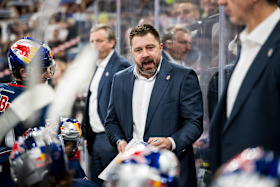
Athletes and coaches consciously dedicate their lives to sport. How does this intensify during the playoffs?
David: "From now on, it's all ice hockey. Even if we can allow ourselves a 'day off', your mind is on the game. When it gets warmer now, you can maybe go out in the sun or spend time with the family, that's good and nice, but the next few weeks belong to our sport. And this attitude is often more helpful than a longer break to get into a rhythm. It becomes part of everyday life and you look forward to it. It only gets weird when the season is suddenly over and you don't know what to do now (laughs)."
The playoff mindset plays a big role. What else counts as your experience from the last two years, in which you led EC Red Bull Salzburg to two championships?
David: "One of the most important things I've realized after defeats is that you should never overreact. Of course, if you lose a whole series, it's over and you can turn things upside down. But as long as you're in the race: stay calm. No matter how hopeless it seems. If you're running a marathon and your shoe comes undone, take your time, bend down and tie it again properly. If you throw the shoe away in a hurry, you won't finish the race successfully. I hope you understand what I mean (laughs). The Navy Seals have a credo: slow is smooth and smooth is fast. I think that's quite good. You should also never overreact emotionally. After a defeat, apportioning blame really doesn't do anyone any good."
So team cohesion is fundamental for you in the playoffs.
David: "As a team, you're a family. You spend time together in training, on the bus, in the dressing room, on the ice and in the hotel room. It has to harmonize. At the same time, it's clear that each individual will play their part in this story. Two or three players won't win you a championship. The team always has to come first - and that doesn't just apply to the two import players who have to take a break."
And does our team have what it takes to win the championship?
David: "I'm convinced of that. There have been many games this season in which we've proven that. We can beat anyone in this league, even if we're behind. As a coaching team, we try to lay the foundation for the players with our game idea and game plan. The boys then have to take on their roles on the ice. Defensively, offensively or in shorthanded and overtime play. And I've seen enough this year to be able to say: We have a chance!"

Mit Video
Two historic club milestones: Eyewitness Phillip Sinn right in the thick of it// NEWS

“WE RUN THIS TOWN” – The best time of the year is here!// NEWS

Schedule, Format, Tickets: What You Need to Know About the Playoffs// NEWS